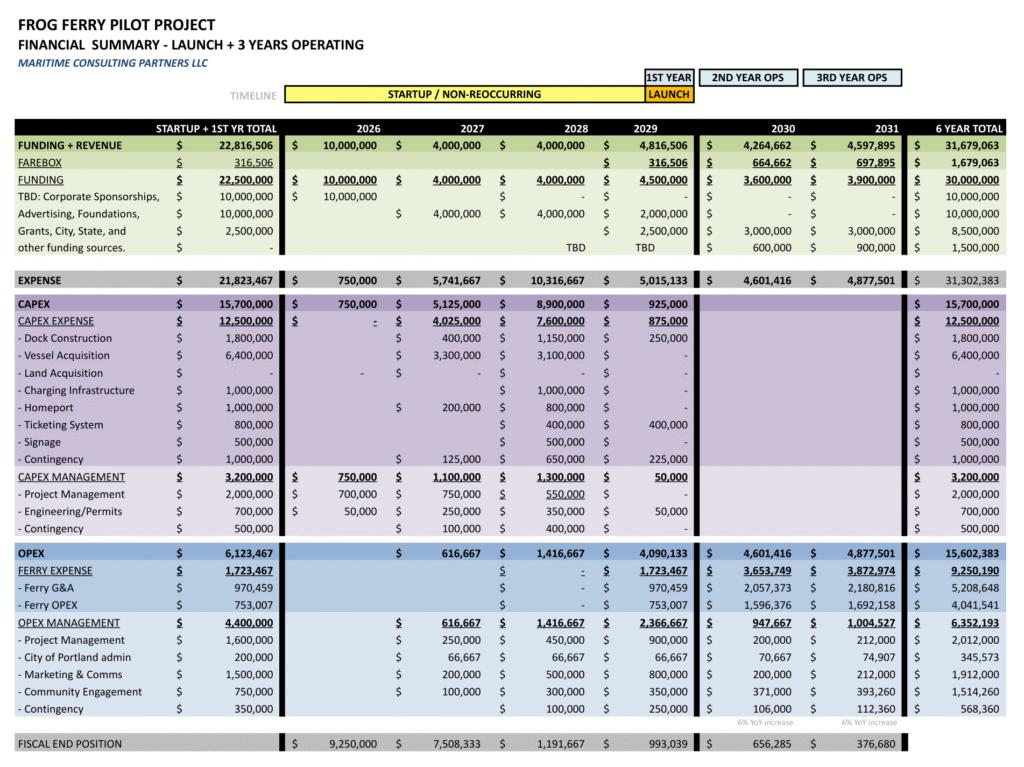
Frog Ferry’s funding strategy is rooted in fiscal responsibility, strategic partnerships, and public-private leverage. The $65 million total project cost is divided into capital and operating components, with funding from local, state, federal, philanthropic, nonprofit, volunteer, and private sources. This approach allowed Frog Ferry to de-risk the pilot phase, demonstrate measurable outcomes, and scale operations through sustainable investment streams.
2017-2024: Since 2017, Frog Ferry has completed over $40 million worth of technical planning, outreach, and feasibility analysis with less than 1% public funding. This included route modeling, feasibility studies, demand modeling, dock assessments, community engagement, government affairs, and extensive planning.
2025-2029: The pilot phase focuses on design-build execution, service launch, and early performance metrics.
- Final design and permitting of one all-electric ferry and two primary dock locations.
- Community outreach and educational programming to support early adoption.
- Charging infrastructure design and installation.
- Workforce recruitment and training program launches.
Funding Overview
The total cost of the project through 1H2028 is estimated at $22 million (before contingencies). This includes approximately $13,500,000 in capital expenses (Capex) and $6,500,000 in operating expenses (Opex). See financial model for detailed costs; these costs are approximations for context.